
Last modified: 2026-10-31 by rob raeside
Keywords: colombia | air force | roundel | fin flash |
Links: FOTW homepage |
search |
disclaimer and copyright |
write us |
mirrors
 image by Jaume Ollé, 5 November 2001
See also:
The Colombian Air Force's full organizational chart (from the Air Force's
official website) is located
here.
The Colombian Air Force's operational units (Air Commands, Air Groups and
Schools) are seen here:
Wikipedia and
www.fac.mil.co)
On the operational level, the Air Force is divided into Comandos Aéreos (Air
Commands), which in turn have several Grupos Aéreos (Air Groups) and these are
divided into Escuadrones (Squadrons). There are also several independent Air
Groups as well, which will most certainly turn into Air Commands when they reach
the proper capacity and infrastructure needed both in manpower and airpower.
These Air Commands and Air Groups are as follows:
- Comando Aéreo de Combate No. 1 (CACOM 1) "CT. Germán Olano Moreno": official
website,
flag,
coat of arms;
- Comando Aéreo de Combate No. 2 (CACOM 2) "CT. Luis Fernando Gómez Niño":
official website, no flag reported on
official website,
coat of arms;
- Comando Aéreo de Combate No. 3 (CACOM 3) "MG. Alberto Pauwels Rodríguez":
official website, no flag reported on
official website,
coat of arms;
- Comando Aéreo de Combate No. 4 (CACOM 4) "TC. Luis Francisco Pinto Parra":
official website:, no flag reported on
official website,
coat of arms;
- Comando Aéreo de Combate No. 5 (CACOM 5) "GR. Arturo Lema Posada": official
website, no flag reported on official
website, coat of arms;
- Comando Aéreo de Combate No. 6 (CACOM 6) "CT. Ernesto Esguerra Cubides":
official website, no flag reported
on official website,
coat of arms;
- Comando Aéreo de Transporte Militar (CATAM) "BG. Camilo Daza Álvarez":
official website,
flag (source:
http://www.catam.mil.co/index.php?idcategoria=11898 ),
coat of arms;
- Comando Aéreo de Mantenimiento (CAMAN) "MY. Justino Mariño Cuesto": official
website;
- Grupo Aéreo del Amazonas (GAAMA): no official website yet;
- Grupo Aéreo del Casanare (GACAS): official
website, no flag
reported on official website, no CoA reported on official website;
- Grupo Aéreo del Caribe (GACAR) "TC. Benjamín Méndez Rey": official
website,
flag (source:
http://www.gacar.mil.co/index.php?idcategoria=1555 ),
CoA;
- Grupo Aéreo del Oriente (GAORI) "CR. Luis Arturo Rodríguez Meneses" (will soon
become CACOM 7): official website, no
flag reported on official website,
coat of arms.
It is important to notice that these Air Commands were first called Comando
Aéreo de Apoyo Táctico (CAATA), (Air Tactical Support Command)
Regarding the schools, these are:
- Escuela Militar de Aviación (EMAVI) "Marco Fidel Suárez": official
website, no flag
reported on official website,
coat of arms;
- Escuela de Suboficiales FAC (ESUFA) "CT. Andrés Maria Díaz Díaz": official
website,
flag,
coat of arms;
- Instituto Militar Aeronáutico (IMA) "CT. José Edmundo Sandoval": official
website,
flag,
coat of arms.
Esteban Rivera, 26 September 2010
Last February 8, 2013, a new
Combat Air Command was set up with its respective
flag. A picture gallery of this activation ceremony can be seen
here.
Esteban Rivera, 11 February 2013
The pattern followed by these Units' Standards (flags) is the plain Air Force flag with the respective unit's coat of arms, as seen here:
 image
located by Esteban Rivera, 26 September 2010
GACAR Standard, taken from:
http://www.gacar.mil.co/recursos_user/imagenes//unidades/gacar/2010/DSC_7705.JPG
Also, each unit has its own War Flag, which is the Colombian tricolor, plus the
name of the unit on the lower red fringe surrounding the CoA , as seen here:
 image
located by Esteban Rivera, 26 September 2010
CACOM War Flag, taken from:
http://i.esmas.com/image/0/000/006/083/ALVAROURIBE-P.jpg
As mentioned before, an Air Command has several Air Groups. These Air Groups
have in turn their own flags, as seen in this example:
 image
located by Esteban Rivera, 26 September 2010
Standard of GRUCO-41, taken from
http://www.cacom4.mil.co/index.php?idcategoria=3015.
The CACOM-4 has an Air
Group, called Grupo de Combate (Combat Group) 41 (GRUCO-41), and this is its
Standard). The GRUCO-41 has an eagle as its insignia, seen
here.
Esteban Rivera, 26 September 2010
Today the country's Congress published "Ley 2302 del 12 de Julio de 2023"
which states in Article 5 the new denomination of the Colombian Air Force to
become "Fuerza Aeroespacial Colombiana" upon publication. This was announced
yesterday during the inauguration of F-Air 2023 Edition, held in Rionegro but
the Law was not published until today.
This change is in line with a
rather recent trend in which several countries have either incorporated a new
Branch of Service in their military and established an Aerospace Force, or
renaming their current Air Force as Aerospace Force.
Esteban Rivera,
14 July 2023
By Law 126 of December
31, 1919, the "Escuela Militar de Aviación" (Military Aviation
School) was established with the aim of training pilots who eventually
would be part of the fifth branch of the National Army and by
Law 102 of December 31, 1944 the
country's Aviation comprised the now designated "Fuerza Aérea
Nacional" (FAN) or National Air Force and the Civil Aviation,
which in effect separated the Army's Air Arm and created a newly
independent Force.
Source: [1],
[2],
[3,
and [4].
Esteban Rivera, 5 May 2025
I located the Air Force flag
at elpibe.urc.net.co.
Esteban Rivera , 19 May 2000
The flag with the crest and white background seems to be the
official one. They probably changed it since I remember
seeing the same coat of arms but on a different background (more
like a light blue one). In every TV appearance of the Air Force
flag, I have always seen that flag.
Esteban Rivera, 30 May 2000
Photo of the flag at www.fac.mil.co/simbolos,
arms at www.fac.mil.co.
Jaume Ollé, 24 November 2001
A government decree no. 126 of 31 December 1919 to form aviation element of
Army was the first step for the establishement of Fuerza Aérea Colombiana. On 4
April 1922 Aviacion Militar was formed and it was renamed in 1943 Fuerza Aérea
Nacional and renamrd again in 1947 to its current name. Homepage at www.fac.mil.co
.
Dov Gutterman, 14 June 2004
The FAC flag was established by Resolution on May 24, 1971.
Source: www.fac.mil.co.
E. R., 7 July 2008
 image
located by Esteban Rivera, 08 March 2016
Since all official flags have the
tricolor plus coat of arms as their template,
here's an actual picture of the Colombian Air Force War Flag
showing the same design pattern and below the initials FAC.
Image taken at an Air Force Base on March 5, 2016.
Esteban Rivera, 08 March 2016
 image by Jaume Ollé, 5 November 2001
Light blue, the national flag in the canton, the air force
roundel (8 points star) in the fly.
Source: Christian Fogd Pedersen: Moussault's lexicon
van vlaggen en wapens (Alverdens flag i farver), 1980 [ped80].
Mark Sensen, 22 June 1997
Air Force ensign: Light blue field with national flag in
canton and roundel (5 points star) at lower fly
Source: Album des Pavillons (1995) [pay].
Ivan Sache, 12 August 1999
I have two books on roundels, both of which say that the star
has had five points since the nineteen-fifties. One says that
before that time the star had ten points
John Ayer, 14 September 1999
From www.geocities.com/Pentagon/7978/facres/simbolos.htm:
ENSIGN (Roundel): This is the ensign that the Colombian Air Force
uses since 1950 in all and each one of its aircraft which goes by
the following pattern: On top of the left side (wing), below the
right side (wing) and on the tail, one on each side. In the
middles it has a five-pointed white star and on its borders is
the national tricolor inverted.
Esteban Rivera, 30 May 2000
In Znamierowski's book [zna99]
at p. 85: the text states: "...and Colombia have the air
force emblem in the centre", but the picture shows the air
force flag with the roundel, not an air force emblem
M. Schmoger, 16 July 2000
The image is probably of the old flag at top and the text is
about the Air Force New Flag
Dov Gutterman, 17 July 2000
The Album 1995 issue [pay] show
another flag wich is omitted from Album 2000 [pay00], but I think only due to the
editorial policy and not because the flag is obsolete. That is
the Air Force Ensign, of the clasical pattern - light blue with
the national flag in canton and the roundel in fly. I think that
this flag is not obsolete indicated, and that the Air Force flag
of different design does not replace it - this other flag serve
entirely different function - it is the flag of the Air Force as
a branch of the defence forces, in the same way as there are
similar flags for other branches.
Željko Heimer, 23 May 2001
 image by Jaume Ollé, 5 November 2001
 image by Carlos Thompson, 2 June 2003
Air Force (FAC)
In the front dor of the Military Hospital, in Bogota,
Colombia, there are three flags in plain color: dark blue, light
blue and red. I supose that the flags are just versions without
the coat of arms, of the flags of the Army (EJC), Navy (ARC) and
Air Force (FAC).
Carlos Thompson, 2 June 2003
António Martins wrote: "These seem to follow the
british pattern...". Given that Colombia military airfield
flag follows a British pattern: sky blue flag with national flag
in the canton and roundel in the fly; and that Britain had a lot
of influence in Latin America post independence, that would be a
fair guess.
Carlos Thompson, 3 June 2003
 image by Jaume Ollé and Eugene Ipavec, 19
August 2008
Flag spotted on 6 June 2008 at Eldorado Airport, Bogota. It
was hanged on an hangar and I believe that it belongs to one of
two Air Force units: CAMAN or CATAM that are located in this
airport.
E.R., 19 August 2008
air.gif) image by Jaume Ollé, 5 November 2001
This is the Colombian Air Force's Crest. It reads "Sic
Itur Ad Astra", which means "Like this you go to the
stars".
Esteban Rivera , 19 May 2000
From www.geocities.com/Pentagon/7978/facres/simbolos.htm:
THE EAGLE OF GULES: She was made the symbol of aviation
itself. As the queen of all birds she is the symbol of the
empire that the AIR ARM exerts over Colombian skies, winds and
storms; she is a living image of the power and freedom of our
fatherland. Her color is gules or blood and/or fire red, that war
or martyr heroes have; it speaks clearly about the transparence
and energy of love. It also shows the strength of the
spirit and and the ability to dread, primary virtues of those who
are part of the Colombian Air Force and incarnates in its blason
, manhood, victory, valor, ellegance and courage. The center of
the crest is in Azure (Turqueoise Blue) with an horizontal chief
that holds two sabre blades, meaning guard, truth, loyalty
and beautifulness. Its title, also in gold, says "SIC ITUR
AD ASTRA" which translates "Like this you reach the
heigths". The golden color symbolizes the "light
and commitment, the greatness and wisdom". This is, at a
glance, the formidable heraldry of the crest that was made into
the symbol of our institution. Its motto was taken from
Eneida de Virgilio in his book IX, Chapter V. The crest's origin
was from a contest promoted by the Colonel Arturo Lema Posada,
then commander of the military aviation and formalized by the
Decree No. 2963 of the 26th of December of 1944, being President
of the Republic Alfonso López Pumarejo and Minister of War
(Today Minister of Defense), General Domingo Espinel.
E. R., 30 May 2000

Flag
image by Eugene Ipavec, 10 August 2009
.gif)
Coat of Arms
image by Eugene Ipavec, 10 August 2009
ASURFAC (Asociación de Suboficiales en Retiro de la Fuerza
Aérea Colombiana, Retired NCO's of the Colombian Air Force) is
an organization that has its own symbols. It consists of the
plain Air Force flag pattern with the Coat of Arms of the ASURFAC
on the middle.
E.R., 10 August 2009
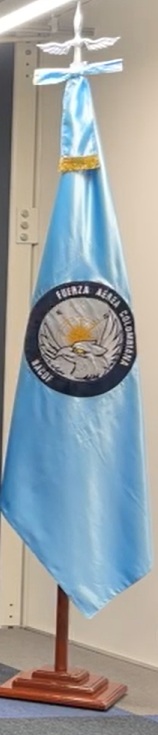 image
located by Esteban Rivera, 27 April 2026
Source:
https://www.facebook.com/FuerzaAereaCol/videos
The "Base Aérea Comando Fuerza Aérea Colombiana, BACOF" (Colombian Air Force Command Air Base), colloquially known as "Equipo Azul" (Blue Team) is the military unit in charge, established on April, 2018 in Bogotá with the mission is "to provide logistical, security, and defense support to the Colombian Air Force Command Headquarters and the administrative management of the Colombian Air Force Air Groups, Joint Task Forces, and (the) Commander".
Sources:
https://www.fac.mil.co,
https://www.fac.mil.co,
https://www.facebook.com/FuerzaAereaCol
Esteban Rivera, 27 April 2026
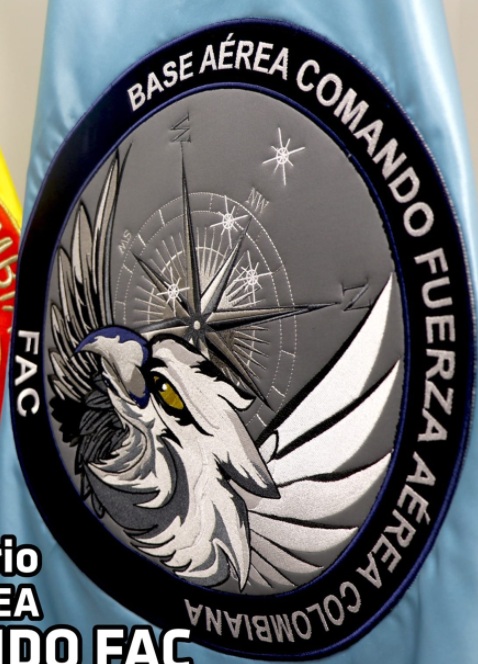 image
located by Esteban Rivera, 27 April 2026
Source:
https://www.facebook.com/FuerzaAereaCol
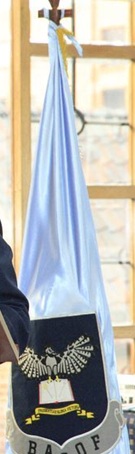 image
located by Esteban Rivera, 27 April 2026
Source:
https://www.facebook.com/FuerzaAereaCol. Picture taken in 2019.
 image by Eugene Ipavec
The Acción Social FAC Nuestra Señora de Loreto (FAC Social
Action Our Lady of Loreto) is a non profit organization made up
of wives of Air Force Active and Retired Officers that work
voluntarily to support the families of the homes of the most in
need of the Air Force. It was established in 1972
The Lady of Loreto was chosen because it represents protection
for the houses and the families that live there
Sources: www.fac.mil.co, www.corazones.org
and wikipedia
The Logo can be seen on the header of the website they have. The
flag is on a horizontal plain yellow background with the logo on
the middle, as seen in the pictures:
E.R., 10 December 2009
The Air Force Social Action "Our Lady of Loreto" was established in 1972.
Source:
https://www.fac.mil.co/?idcategoria=237
It has a new flag, the colors being the same, but with a new logo.
This picture taken on July 11, 2013
during the F-Air air show.
For additional information go to: Acción Social "Nuestra Señora de Loreto" (official
website)
Esteban Rivera, 21 December 2013

.gif)
1. image: [1] from Facebook
2. image from fac.mil.co
On January 28, 2025 during the departure ceremony for the "VII Campaña Antártica" (VII Antarctica Campaign) the mission pennant is observed. This is a scientific
oriented international hemispheric cooperation exercise that has involved several countries over the years. Previous missions have taken place in 2015, 2018, 2019, 2020, 2023,
2025, all of them aboard the Lockheed C-130 FAC1005. It is part of the "XI Expedición Antártica" (XI Antarctica Expedition).
The pennant features the "VII Campaña Aérea" mission patch over a vertical sky blue stripe next to the Colombian tricolour. It is possible that previous missions may have used pennants as well
using previous patches: the patches of V at fac.mil.co and VI
at fac.mil.co
Esteban Rivera, 3 February 2025


